Es mostren els missatges amb l'etiqueta de comentaris REGNE UNIT. Mostrar tots els missatges

dimecres, 9 de novembre del 2016

ARTICLE MOLT INTERESSANT. CAL LLEGIR-LO I ENTENDRE'L*

Catalan President Artur Mas appeared in court on 15 October in relation to the symbolic referendum on independence from Spain held on 9 November 2014. Zoran Oklopcic** writes that with Mas and his Junts pel Si coalition committed to setting Catalonia on the path toward a declaration of independence following elections in September, the eyes of the international community are on how the Spanish government chooses to respond. He argues that the strategy of the Catalan independence movement now rests on bringing international pressure on to Madrid by highlighting the government’s unresponsiveness to peaceful demands for a referendum.
Until very recently, there was something strange about the way in which Catalan independence had been pursued. While admirable in its peacefulness, to a foreign observer the claims of Catalan sovereigntists nonetheless appeared farcical in their enduring assertions of the ultimate sovereignty of the Catalan people, nonetheless accompanied by their consistent deference to the authority of the constitutional organs of the Spanish state. While the 2013 Declaration of Sovereignty affirms the right of the Catalan people to decide its political future, in autumn 2014, the Catalan Government dutifully submitted to the authority of a Spanish Constitutional Tribunal. Following its judgment, the Catalan authorities relinquished their authorship over the consultative referendum on independence planned for 9 November 2014, allowing it to proceed under a name designed to be less offensive to the Spanish constitutional order: a ‘consultation’.
The ‘consultation’ proceeded informally, without the benefit of the government’s role that would have reliably counted votes or prevented voting fraud. By submitting to the authority of the Spanish constitution, the Catalan Government was willing to diminish the perception of the legitimacy of the expression of the sovereign will of the Catalan people. It was also willing to accept the risk that present enthusiasm for independence might diminish – which seems to have happened – following yet another ‘false alarm’.
Compare this with the way in which the Slovenian and Croatian governments pursued their independence projects in 1990-91. Even before they organised a popular vote, they made the applicability of the federal constitution conditional on its conformity with their legal orders. In doing so, they explicitly rejected the ultimate legal authority of the federal constitutional court. Once they organised a popular vote on sovereignty, they did it only once. When they did, they didn’t call it a ‘consultation’ or ‘plebiscitary election’, but a referendum on independence.
Needless to say, the differences between Spain in 2015, and Yugoslavia in 1991 are so vast that they almost prevent any comparison. Nonetheless, they do draw attention to the half-hearted way in which Catalan sovereigntists have pursued their project so far. Did they really expect a different response from the Spanish state every time when they, in simulating Catalan sovereignty, submitted to Spanish constitutional authority?
Is this oxymoron the result of their naïve belief that the repeated simulations of the former, will end up persuading the Spanish politicians to abandon their commitment to the latter? Or is it, on the other hand, the result of their cynical political calculus; that the simulacrum of Catalan sovereignty would have exhausted Catalans’ enthusiasm for independence, and save Catalan politicians from a full-blown confrontation with the Spanish state? Even the comparatively more radical political programme of Junts pel Si – which explicitly declared its readiness to unilaterally declare independence – has only committed to that after the end of the 18-month long constituent process.
So why are Catalan parties delaying the process if it cannot be expected that Spain will change its mind? Why set ‘constituent’ tasks for yourself if they can both build, as well as corrode the enthusiasm for independence in the months ahead? Without a credible account of the debates in the inner circle of sovereigntist strategists we can only speculate. What seems reasonable to assume, however, is that behind the meandering road-map of Catalan independence there appears to be a twin strategy of provocation and validation, aimed not primarily at the Catalans or the Spanish, but rather at the international audience. By repeatedly asserting the diluted version of their sovereignty, by exploiting the loopholes of the Spanish constitutional framework, Catalan sovereigntists seem to have hoped – and perhaps still do – to provoke the Spanish state to de-legitimise itself in the eyes of the international community.
On the other hand, the second prong of this strategy seeks to dignify the secessionist project. The longest human chain, the tallest human tower, popular consultations (2014), plebiscitary elections (2015): these are not simply the manifestations of the ‘will of the people’, but are rather pieces of political theatre with a specific rhetorical purpose. Against the charges of political manipulation, radicalism, ethnocentric bigotry or economic selfishness, they sought to persuade the relevant audiences within and outside of Spain of the patience, reasonableness, authenticity, resilience and inclusiveness of Catalan aspirations for independence.
Time will tell whether the project of Catalan independence will be successful. What is worth noting is not only its political, but also its wider normative context. While the constitutional documents of Croatians and Slovenians in 1991 proudly invoked their international legal right to self-determination, Catalans have been much more self-aware of the nuances in contemporary international jurisprudence. They know that there is no juridical consensus that would enable them to persuasively speak about their right to external self-determination in 2015.
They also know that their best chance to gain support of those who take international law seriously – irrespective of that law’s fuzziness – is to either establish effective control over Catalonia without violating peremptory norms of international law, or to demonstrate that they have been oppressed systematically by the Spanish state. In provoking Spain by simulating their sovereignty before they declare independence unilaterally, they hope to achieve one or the other.
Equally, the project of Catalan independence occurs in the era of subtle but profound mutations of the idea of liberal-democratic constitutionalism. Unlike Spain, Canada and the United Kingdom were not only willing to tolerate the secessionist aspirations from one of its constitutional units, but have been responsive towards them in a most striking way.
In Canada, the clearly affirmative result in a referendum would have led to ‘good faith’ negotiations toward the secession of Quebec. In the United Kingdom, the same result would have guaranteed the independence of Scotland. This comparative constitutional background of Canada and United Kingdom also sheds a fresh light on the so-called ‘right to decide’. Rather than being seen as the radical democratic antithesis to modern constitutionalism, it is better seen as a way to uncover the ‘scandal’ of the Spanish constitution’s unresponsiveness.
Without the willingness to escalate their resistance further, the success of the project of Catalan independence will depend on the combined response of the Spanish state and the international community. Catalan strategies of simulated, deferred sovereignty seem to assume that Madrid will prove incapable of maintaining proportionality in its political and legal reactions to the escalating disruptions of the Spanish constitutional order in Catalonia. They also seem to assume that the international community will at some point choose to interpret the Spanish unresponsiveness to peaceful Catalan demands as a political scandal that requires a solution that satisfies their substance.
It is hard to say whether these assumptions are correct. But if they are not, Catalan sovereigntists will be forced to contemplate the conclusion which they sought to evade all along: that the evidence of the legitimacy of your project, and the guarantee of its success, lies not in the performance of the dignity of your aspiration, or in the simulation of your sovereignty, but in the ultimate sacrifice of yourself, and others.
*(NOTA: Aparegut a Europpblog, 19.10.2016)
**Zoran Oklopcic – Carleton University is Associate Professor in the Department of Law and Legal Studies at Carleton University in Ottawa, Canada.
Les negretes són meves (J.S.).  Les imatges no apareixen en l'original.

dimecres, 21 d’agost del 2013

SÓN BOJOS, AQUESTS ESPANYOLS!!

En plena paranoia anti-britànica, la cadena 13TV dedica un reportatge a l'enfonsament del HMS Coventry per avions argentins el 1982.

Fent amics a Europa! Ja ens va bé!

Són bojos aquests espanyols!!!!

dilluns, 19 d’agost del 2013

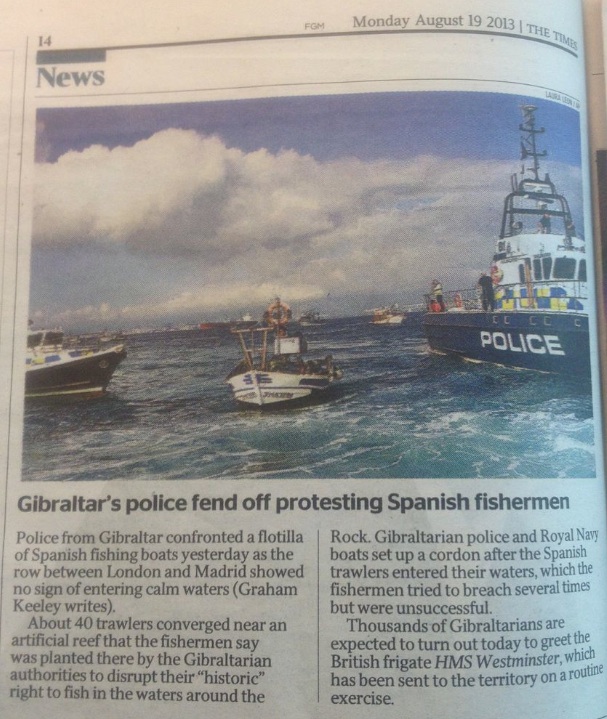
UN BREU A LA 14, AIXÒ SÍ AMB FOTO

Els espanyols, decidits a fer el ridícul, no es queden els últims. Més aviat són deixebles avantatjats. Ara la brunete mediàtica en pes tornen a la càrrega amb el tema de Gibraltar, suposo que per distreure el personal i fer aixecar el patriotisme espanyol en moments de necessitat suprema -llegiu-hi, Catalunya. 

Sempre passa el mateix, com fa 300 anys. Dos es barallen i un tercer rep -llegeixi's de nou, Catalunya.

No m'estranyaria que els espanyols quan rebin la patada a l'entrecuix de part de la Unió Europea, que la rebran, exigeixin compensacions, i aquestes incloguin fer-se el boig en el tema de la Independència de Catalunya. És a dir, deixar-los les mans lliures.

Clar que això només serà possible si els catalans no ho impedim. És feina nostra denunciar qualsevol tipus d'abús dels principis bàsics sobre els que es construeix la Unió Europea, que es detallen en l'article 2 deL Tractat, com ja he exposat manta vegades en aquest bloc i en altres mitjans.

Per la seva banda, el més llest de la pel.lícula, és a dir, el Regne Unit, redueix el guirigall a l'estret de Gibraltar. Fixeu-vos que fins i tot el The Times, en parla en un breu de la pàgina 14. Això sí, petita victòria espanyola, amb una foto -més aviat petita...

I és que hi ha coses importants -com el retorn de la sospita que Lady Di va ser assassinada.., a la qual el venerable diari dedica la portada....- i coses que no ho són.

dilluns, 25 de març del 2013

DESPROBLEMATITZAR ESPANYA

Fa uns anys, alguns oficials dels serveis de contraintel.ligència dels Estats Units van queixar-se del fet que Espanya no dedicava prou recursos per lluitar contra el terrorisme islamista. Aquest fet posava en perill no només els ciutadans espanyols, que de fet ja havien estat víctimes d’uns sagnants atemptats múltiples, que si no van fer més morts és perquè els activistes van suposar que els trens de rodalies complirien els seus horaris establerts, com passa, en general a Europa. També posava en perill, pel cap baix, tots els ciutadans de l’espai Schengen, un espai on es permet la lliure circulació dels ciutadans que hi viuen. De retruc, també posava en perill els milions de visitants que entren en aquest espai, al qual pertanyen autèntiques potències turístiques com són França, Itàlia, a banda, és clar de la pròpia Espanya. I no cal dir que una part d’aquests turistes forasters, procedien dels Estats Units. Els americans afirmaven que els seus col.legues espanyols dedicaven quasi tots els seus esforços a lluitar contra ETA i el seu entorn.

Amb l’aparent desactivació del conflicte armat -que no el polític- al País Basc, els espanyols van començar a fer cas a les pressions aliades i van començar a dedicar actius contra el terrorisme islamista. També a formar un grup d’experts en aquest fenomen i molt particularment en el cas del terrorisme islamista al Magrib.

Però vet aquí que a partir del 2006, l’independentisme democràtic català -és a dir, basat exclusivament en la mobilització participativa i l’activisme digital i presencial- va començar a treure el cap i va començar a caminar amb pas ferm: a banda de la manifestació pel dret a decidir del febrer, a l’any següent va tenir lloc la de les infrastructures, que no deixava de ser una excusa, i que va registrar una participació notable. Després li va seguir la manifestació a Brussel.les, del 2009, un dels moments més èpics, gosaríem dir. Del brou de cultiu d’aquesta manifestació va sorgir la proposta de fer un referèndum per la Independència a la localitat d’Arenys de Munt, el setembre d’aquell mateix any. Això va obrir les portes de bat a bat a tot el procés de les consultes, que en va ser un enorme dinamitzador. La situació encara va créixer en tensió arran de la sentència del Tribunal Constitucional espanyol va anul.lar determinats articles del nou Estatut i va marcar els límits del poder de les autonomies. En la sentència es dictaminava el caràcter subsidiari o secundari de Catalunya respecte l’estat. Això va fer obrir molt els ulls, a determinats sectors del país que fins llavors s’havien atipat de donar una nova oportunitat al consens territorial, debades. La immediata manifestació del 10 de juliol del 2010, malgrat les enormes vacil.lacions que la van caracteritzar, va ser una resposta força contundent. La crisi econòmica i l’actitud dels successius governs espanyols entre el 2010 i el 2012, tant d’un color com de l’altre, a banda és clar d’un activisme sense aturador de l’independentisme civil, va congriar el gran tsunami de l’11S2012 i tot el que després s´ha esdevingut.

En tot aquest procés els serveis d’intel.ligència espanyols es van quedar amb un pam de nas. Ells es pensaven que el procés tard o d’hora quedaria aturat per CiU. La victòria convergent en les eleccions del 2010 i sobretot el triomf brutal d’una CiU encapçalada per Duran i Lleida en les eleccions espanyoles del 2011, assenyalava clarament que el pati català estava sota control. Clar que tot plegat va començar a canviar amb la manifestació monstre i amb l’anunci de Mas de convocar eleccions i impulsar una consulta. Llavors el cangelo espanyol es va disparar. Només cal llegir la premsa entre setembre i novembre per comprovar que la por es va apoderar d’Espanya i van començar els atacs des de la caverna i el govern de Madrid va improvisar una ofensiva en els mèdia internacionals. Tenien coll avall que Mas guanyaria de carrer i veien un panorama més que desolador.
Però vet aquí, que el poble de Catalunya, va decidir altrament. La svictòria amarga de Mas, va omplir de joia els espanyols, i com era d’esperar, va donar pas a una nova ofensiva en tota regla, ara utilitzant particularment l’eina de l’ofec financer per sotmetre el govern de Barcelona. I a l´hora impulsar els altres fronts (cultura, justícia, policia, etc.).
A tot aquest procés la comunitat internacional va assistir al.lucinant. Veure un 20% de la població d’un estat europeu manifestant-se per la Independència era quelcom inaudit. Brutal. Però encara més brutal, i inaudit va ser veure com aquest mateix poble decidia fer-se la vida més complicada i castigar el polític que precisament, per primera vegada en dècades, com a mínim des dels anys trenta, decidia jugar-se-la per la Independència del país. No m’estranyaria que en les reunions dels governs europeus més d’un exclamés, “estan bojos aquests catalans!“.

Però els fets darrers han demostrat que realment qui estan bojos no són precisament els catalans. El President Mas, ha aconseguit a empentes i rodolons, construir una estratègia de transició nacional basada en un pacte amb la segona força política del país, la qual sembla més pendent d’aconseguir el sorpasso en els propers comicis, que d’assolir la independència el més aviat possible. És doncs, un aliat que mereix més aviat poca confiança, ple de complexos i d’ambició, per no dir de comptes pendents. Tot i això s’han fet passos endavant, just és reconèixer-ho.
I un d’aquestes passos és l’oferta permanentment oberta de dialogar amb Madrid, de tu a tu, com s’acostuma  a fer entre gent civilitzada. Però els espanyols no són precisament, addictes al diàleg. De fet, la comunitat internacional, que ja porta segles aguantant les ximpleries dels espanyols, ja saben com les gasten: un tancament a banda total dels espanyols a qualsevol tipus de negociació, arribant a extrems ridículs, fins que els fets consumats demostren que la seva fatxenderia no era més que una façana, perquè els espanyols sempre han sortit, sempre, malparats de les seves xuleries i actituds quixotesques. Són tan previsibles que repeteixen. No debades no es cansen de repetir allò de la “indisolube unidad de la nación española“, quan de fet si hi ha alguna cosa soluble al món mundial, és precisament la nació espanyola. O si no que els preguntin a tots els estats llatinoamericans, que fins i tot ara encara els estan donant per sac amb les nacionalitzacions d’empreses espanyols quan els passa pel cap. No s’atreviran a fer-ho amb els xinesos, no. Ni amb els alemanys o els francesos, no.


Ara bé, descartats per sentit comú els fets consumats, és obvi que l’actitud del govern espanyol contrasta amb la d’altres governs que han hagut de fer front a moviments independentistes. Per exemple els casos de Canadà i de la Gran Bretanya, on s’han obert vies negociadores que sembla que permetran una resolució civilitzada de la qüestió. Per contra, allò que preocupa la comunitat internacional, és el tancament a banda de Madrid a qualsevol negociació. De fet, Espanya s’està convertint en un soci dissonant dins la UE, i que no dubta en equiparar-se a Sèrbia, quan els seus ministres comparen, de forma ben ridícula, per cert, Catalunya amb Kosovo.
Cal aprofitar des de Catalunya, aquest tancament a banda dels espanyols. Cal estigmatitzar-los i convertir-los en uns pàries. Cal fer que es fregeixin en la seva pròpia salsa, cal que morin del seu propi verí. Però no menyspreant-los, sinó aprofitant la seva obcecació malaltissa i la seva més que justeta cultura democràtica.
Només des d’una fermesa en el compromís amb la Independència i en la via democràtica per assolir-la, obtindrem l’èxit que necessitem com l’aire que respirem. I d’aquesta manera, Espanya deixarà de ser un problema, fins i tot per als serveis d’intel.ligència mundials.

(NOTA: Post penjat al DGS, el 20.03.2013)